
 0
0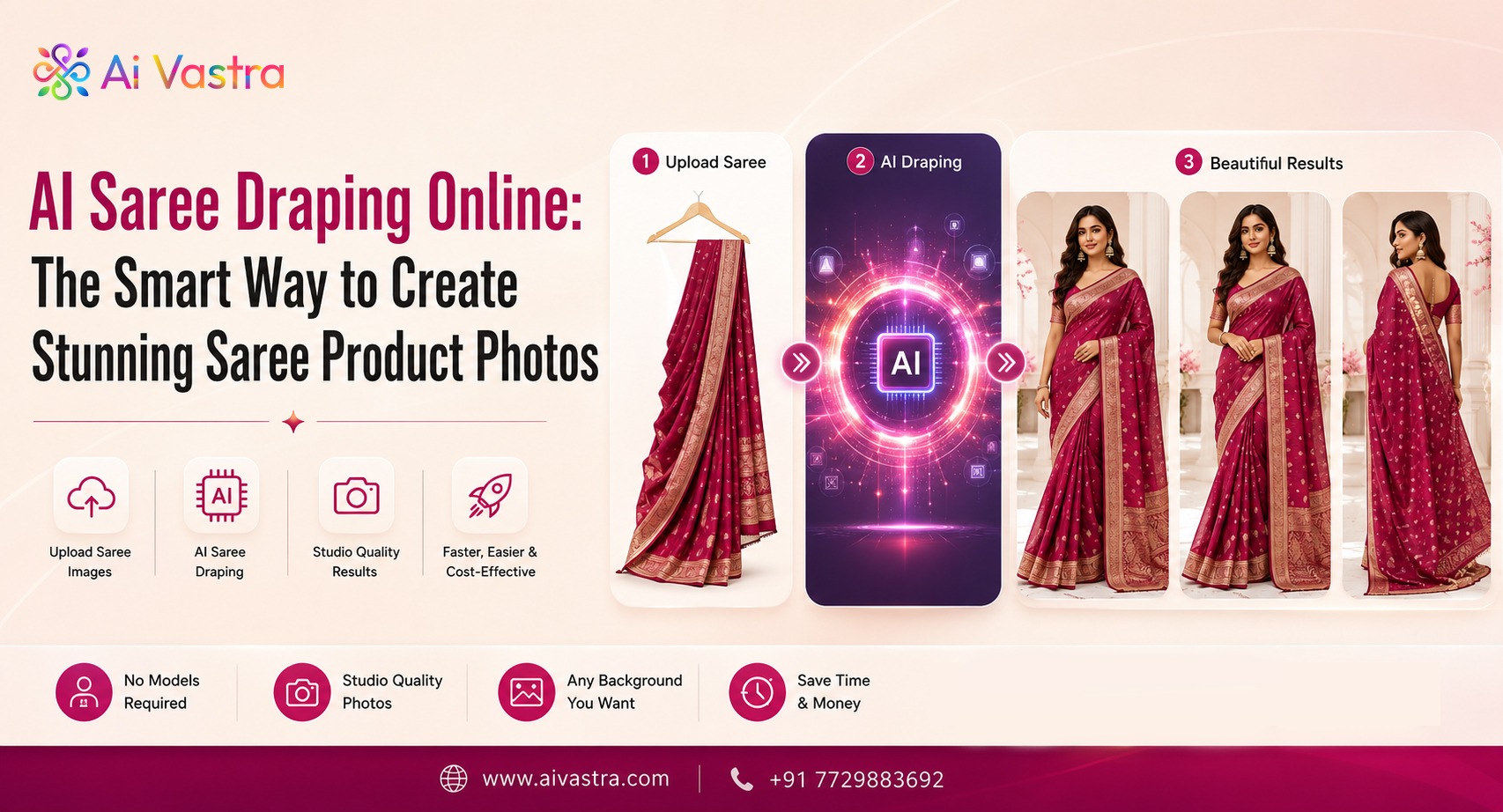
Key Takeaways
- AI saree draping online delivers realistic, on-model saree catalogue images without any studio or physical shoot
- AI Vastra preserves zari embroidery, silk sheen, pleat structure, and pallu drape accurately — across Kanjeevaram, Banarasi, chiffon, georgette, and cotton sarees
- Traditional saree photoshoots cost ₹800–₹3,000 per image and take weeks; AI saree draping reduces cost by up to 80% and delivers same-day
- All major saree types and regional draping styles are supported
- A free trial is available — letting saree sellers test the output with their own designs before committing
A Kanjeevaram saree with hand-woven zari borders deserves a catalogue image. A flat-lay on a white bedsheet doesn’t.
For saree manufacturers, wholesalers, and D2C sellers, this is the daily tension. You have beautiful products. Getting them photographed properly — draped correctly, styled authentically, presented professionally — requires a model, a studio, a photographer, and a week of coordination, for one design. You have three hundred.
AI saree draping online solves this problem completely. You get realistic, on-model saree catalogue images with accurate pleating, pallu drape, and fabric detail — generated within hours, no studio required.
TL;DR: AI saree draping online uses artificial intelligence to digitally drape your saree on a realistic AI model — preserving zari detail, fabric texture, and regional draping styles — and delivers professional catalogue images the same day you upload.
What Is AI Saree Draping and How Does It Work?
AI saree draping involves the use of AI technology to simulate the draping of a saree on a simulated human figure, capturing the intricate details of the fabric, the pleats, pallu and any embroidery, all without a single shoot.
The traditional photo shoot demands the presence of an actual model to wear the saree, a celebrity photographer to pose her in the appropriate position and the lighting required. If you’re looking for some specific savings, here are few instances of how you can save by draping your saree using AI online:
Here’s exactly how it works with AI Vastra:
- Upload your saree image — flat-lay photograph, fabric scan, or product photo
- Choose your draping style — Nivi, Bengali, Gujarati, Maharashtrian, or other regional styles
- Select your AI model — Indian skin tone, body type, and height that matches your target customer
- AI renders the drape — fabric physics simulate how the saree actually falls, with pallu flow, pleat formation, and border detail preserved
- Download your catalogue image — high-resolution, ready for your store, WhatsApp catalogue, or buyer presentation
This is what makes AI saree draping genuinely useful for manufacturers — it’s not just placing a flat image on a mannequin. The AI understands how fabric drapes, how pleats form, and how different saree types behave differently on the body.
Why Do Traditional Saree Photoshoots Fail at Scale?
Traditional saree photoshoots are designed for a small number of hero products, not for manufacturers who launch 200–800 new designs every season.
The math simply doesn’t work. A full studio photoshoot produces 30–60 finished saree images per day — accounting for draping time, styling adjustments, and multiple angles per design. At that rate, photographing 400 designs takes 7–14 studio days.
That’s:
- ₹7–14 lakhs in studio, model, photographer, and editing costs
- 2–4 weeks before your catalogue reaches buyers
- A scheduling nightmare every single season
AI saree draping online breaks this cycle entirely. Upload 400 sarees, set your draping preferences, and receive finished catalogue images within 24 hours. The per-image cost drops by up to 80%. And you never have to wait for a model to be available again.
As we covered in our guide on AI Catalogue Photography vs Traditional Photoshoots, the cost and time savings aren’t marginal — they’re transformational for businesses operating at manufacturer scale.
How Does AI Vastra Preserve Zari, Pleating, and Pallu Detail?
AI Vastra’s draping engine uses fabric physics simulation specifically calibrated for Indian sarees — preserving zari embroidery, silk sheen, pleat structure, and pallu drape with the accuracy that generic AI tools cannot achieve.
What a generic tool knows about a Banarasi pallu’s form, its affinity to Kanjeevaram silk as opposed to chiffon, and the effect of the pleats’ closeness is quite limited.
AI Vastra has been developed with Indian ethnic clothes as the main focus.
- Zari and embroidery detail — gold and silver threadwork renders with accurate metallic sheen
- Silk and heavy fabrics — the weight and drape of Banarasi and Kanjeevaram silk is simulated correctly
- Lightweight fabrics — chiffon and georgette show the flowing quality that makes them distinctive
- Cotton sarees — crisp, structured draping that reflects how cotton actually sits
- Regional draping styles — pallu length, pleat depth, and tuck positions vary by tradition and are handled accurately
This matters enormously for saree sellers. A buyer looking at a Kanjeevaram knows what it should look like draped. If your catalogue image doesn’t match that expectation, you lose the sale — regardless of how beautiful the saree actually is.
Which Saree Types Work Best With AI Draping Technology?
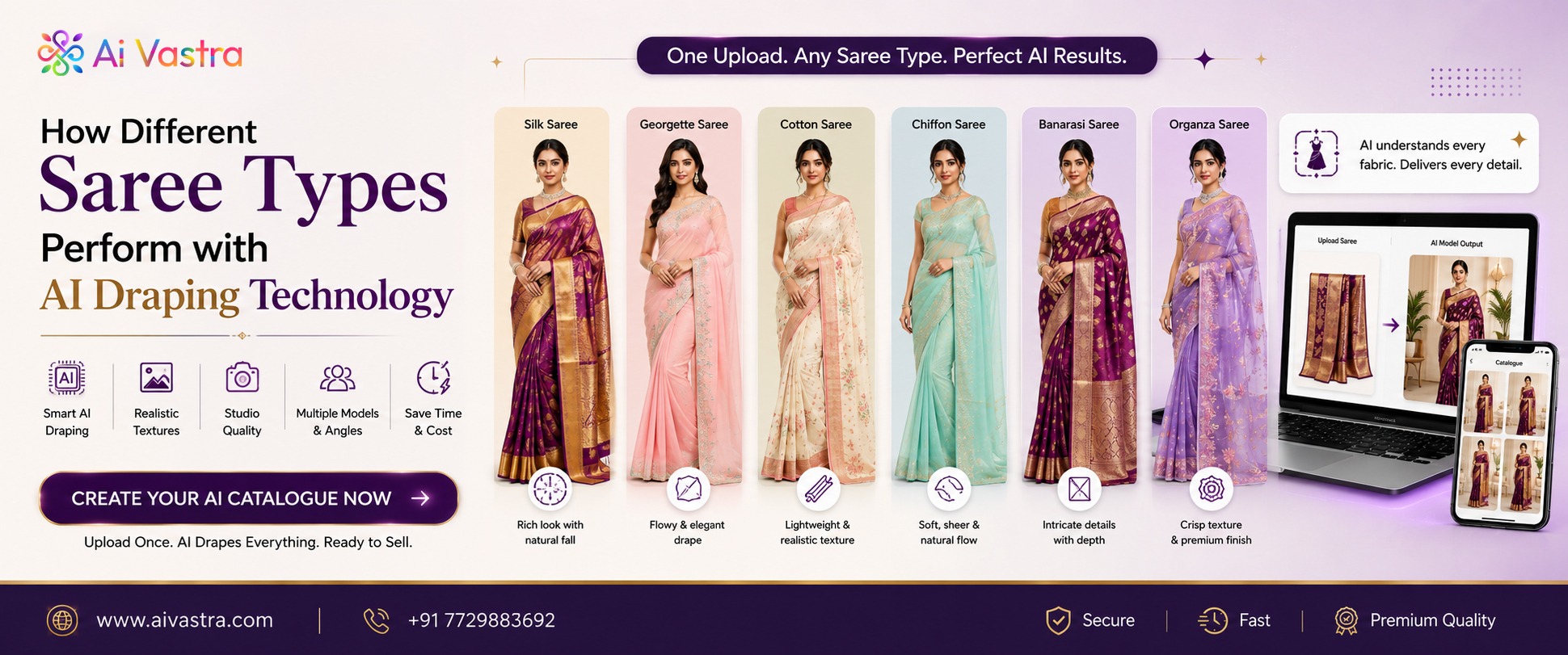
AI saree draping online works across all major saree types — with especially strong results for silk, chiffon, georgette, and embroidered varieties where fabric detail is a key selling point.
Let’s take a moment to look at fabric by the numbers!
Kanjeevaram and Banarasi silk: Dense and formal fabrics. AI Vastra’s physics engine captures the weight and body of silk accurately — including how the zari border falls and how the pallu drapes over the shoulder.
Chiffon and georgette: Lightweight fabrics — chiffon and georgette show the flowing quality that makes them distinctive
Cotton sarees — crisp, structured draping that reflects how cotton actually sits. Cotton sarees are a significant segment of the market, and accurate rendering helps buyers understand the practical, everyday quality of the product.
Embroidered and printed sarees: For sarees where the design itself is the selling point — embroidered borders, block prints, tie-dye patterns — the AI renders the design across the full drape accurately, so buyers can see how the pattern works on the body, not just on a flat surface.
For sellers who combine sarees with other ethnic wear, our article on AI Product Photography for Ethnic Wear covers how the same approach works across kurtis, lehengas, and suits.
Is There a Free AI Saree Draping Tool Online?
Yes — AI Vastra offers a free trial that lets saree sellers and manufacturers generate their first AI saree draping catalogue images at no cost, with no commitment required.
This is important because the best way to understand whether AI saree draping online works for your specific products is to try it with your own designs. The free trial gives you exactly that — real images generated from your actual sarees, so you can judge the output quality before making any decision.
This directly addresses one of the most common questions we see: “Is there a free saree draping tool online I can use to test this?” AI Vastra’s free trial is the answer — and for most saree businesses, the first batch of images is enough to make the decision obvious.
Your sarees deserve catalogue images that match their quality.
AI Vastra is the saree draping tool online built specifically for Indian ethnic wear — with the fabric physics, regional draping support, and embroidery rendering that saree manufacturers actually need.
👉 Start your free trial today and generate your first AI saree draping catalogue images within hours.