
 0
0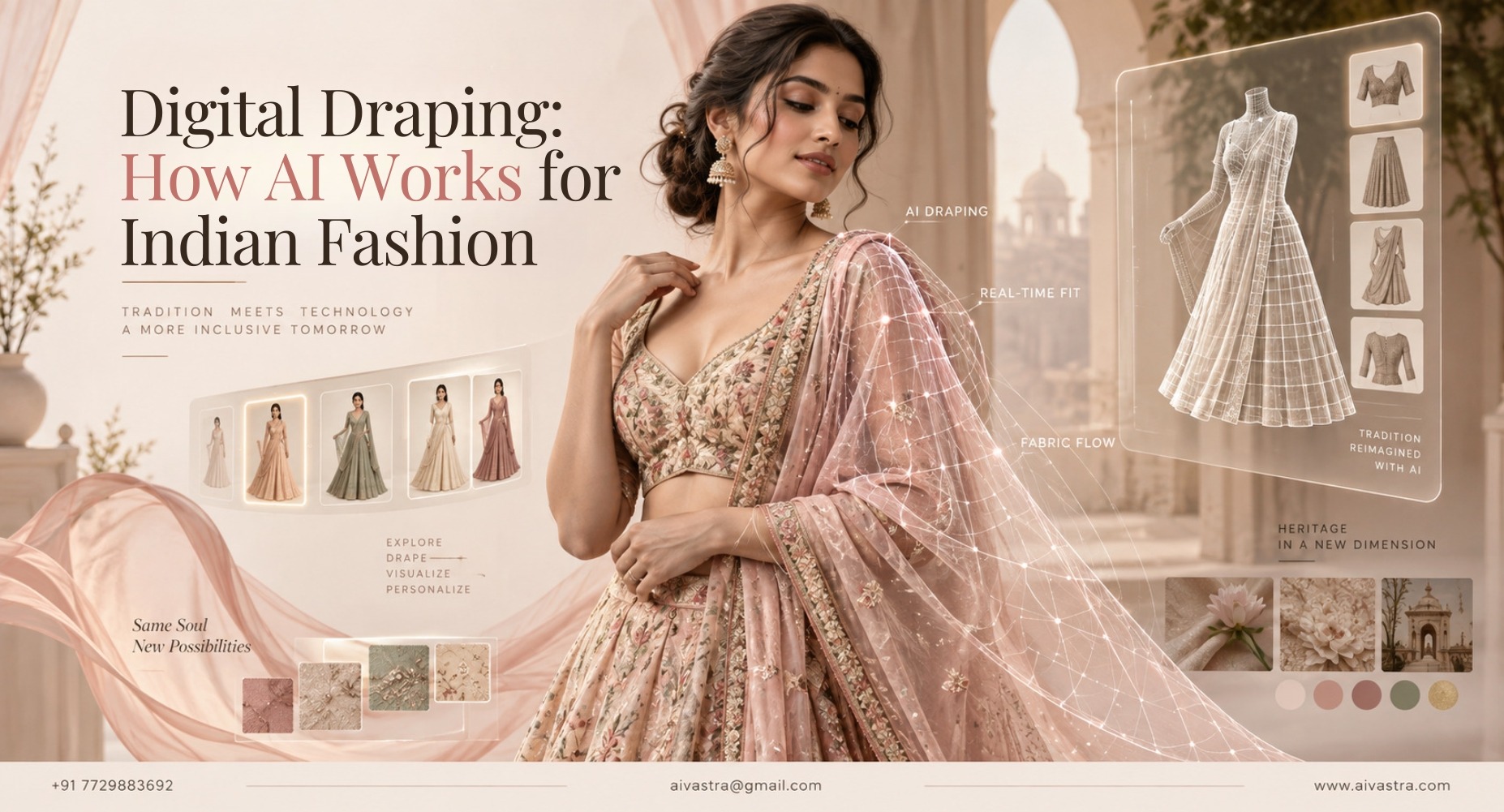
Digital Draping: What It Is and How It Works for Indian Fashion
Before a single thread is cut, fashion designers have always needed to understand how fabric drapes. The methods for answering that question have changed completely.
Traditional draping was physical — a designer would pin real fabric to a dress form, observe how it fell, adjust until it worked, and then translate that into a pattern. The process was tactile, time-consuming, and impossible to scale.
Digital draping AI fashion India has changed this at every level of the fashion industry — from the design studio to the product catalogue. Understanding what digital draping is, how it works technically, and why it matters especially for Indian ethnic wear gives fashion designers, catalogue managers, and technology teams a clearer picture of where the industry is heading.
TL;DR: Digital draping is the computer simulation of how fabric falls and behaves on a body. In Indian fashion, it has evolved from 3D design software used by pattern makers to AI-powered catalogue tools that can accurately simulate saree draping, lehenga silhouettes, and ethnic wear presentation — without physical samples or studio shoots.
What Is Digital Draping in Fashion?
Digital draping is the digital simulation of wrapping, falling, and behaving of a fabric or garment on a three-dimensional body – simulating the physical properties of cloth by software.
In traditional physical draping, the designer works with real fabric on a mannequin or a live person. They observe how the fabric moves because of gravity, how it slides, where it naturally folds, and where it doesn’t want to bend. This tactile process has been the foundation of garment design for centuries.
What is digital draping fashion technology changes: instead of physical fabric and a physical body, software simulates the material properties of the fabric — its weight, stiffness, elasticity, and surface friction — and calculates how it would behave on a digital body form using physics engines.
The output is a realistic visual representation of the draped garment — showing fold patterns, silhouette, fabric fall, and how different fabric weights create different visual effects.
Digital draping technology has been used in professional fashion design since the early 2000s, primarily through 3D fashion software platforms. Its application in AI catalogue photography — specifically for Indian ethnic wear — represents the most significant recent evolution of the technology.
How Has Digital Draping Technology Evolved?
Digital draping technology has evolved through three distinct phases — from manual 3D modelling to physics-based simulation software to AI neural network garment transfer — each generation significantly more accessible and faster than the last.
Phase 1 — 3D Modelling (2000s) Early digital draping required fashion designers to manually build 3D garment models using specialist software. The process was technically demanding and slow — useful for haute couture design development but inaccessible for most commercial fashion applications.
Phase 2 — Physics-Based Simulation Software (2010s) Platforms like CLO3D and Browzwear introduced fabric physics engines that could simulate how real materials behave digitally. A designer would input a fabric’s properties — weight, drape coefficient, elasticity — and the software would calculate how that fabric would drape on a digital body form.
These platforms transformed technical fashion design, allowing pattern makers to test and refine garments digitally before cutting physical samples. They’re now standard tools in the design departments of major global fashion brands.
Phase 3 — AI Neural Network Garment Transfer (2020s) The current generation of AI digital draping technology works differently from physics simulation. Rather than calculating physics from first principles, AI systems trained on large datasets of garment images and body positions learn to predict how a specific garment would look on a specific body — generating photorealistic results in seconds rather than minutes.
This is how AI Vastra’s draping technology works — and it’s what makes it practically useful for Indian fashion catalogue production rather than just design development.
Key Takeaway 1: AI Draping Is Fundamentally Different From 3D Simulation Software — Different Use Cases, Same Core Concept
CLO3D and Browzwear simulate fabric physics for design development. AI Vastra applies learned garment transfer for catalogue image generation. Both are digital draping — but they serve completely different business purposes at different price points and time requirements.
How Does Digital Draping Work Specifically for Indian Sarees and Ethnic Wear?
Digital saree draping online requires significantly more complex simulation than Western garment draping — because a saree’s six metres of fabric involves multiple structural elements (petticoat foundation, pleating configuration, pallu placement) that interact differently depending on fabric type and regional tradition.
This is the technical challenge that makes saree-specific AI draping genuinely difficult — and why general-purpose AI image tools produce poor results when applied to saree catalogue creation.
The structural complexity of saree draping:
A correctly draped saree involves:
- Foundation layer — petticoat and blouse, which determine the base silhouette and how the saree wraps
- Pleating configuration — typically 5–7 pleats tucked into the petticoat at the front, with fold width and pleat depth varying by regional tradition
- Body wrapping — the saree wraps around the body, with the exact path varying by draping style (Nivi, Bengali, Gujarati, Maharashtrian, and others)
- Pallu placement — the decorative end of the saree, draped over the left shoulder with length, fall, and positioning that varies by style and occasion
- Fabric behaviour — a Banarasi silk pallu falls and catches light completely differently from a chiffon georgette pallu or a Kanjeevaram border
Digital fabric draping software India applications for sarees need to handle all five elements correctly and consistently. As we explored in depth in our guide on AI Saree Draping Online, the accuracy of pallu simulation and pleat formation is what separates useful saree catalogue images from ones that look generically draped.
AI Vastra’s training specifically includes Indian ethnic wear — with saree draping patterns, regional style variations, and fabric-specific behaviour built into the model. The result is saree catalogue images where the pleat structure is correct, the pallu fall is appropriate to the fabric weight, and the regional draping style is recognisable to buyers familiar with that tradition.
3D Digital Draping Software vs AI Draping Tools: A Direct Comparison
The key difference between 3D digital draping software like CLO3D and AI draping tools like AI Vastra is their purpose — one is a design development tool for pattern makers, the other is a catalogue production tool for fashion businesses.
| Factor | CLO3D / Browzwear (3D Simulation) | AI Vastra (AI Draping) |
| Primary use | Garment design & pattern development | Catalogue image production |
| Input required | Detailed pattern files and fabric specs | Flat-lay or hanging garment photo |
| Output | Technical 3D garment visualization | Photorealistic catalogue image |
| Time per garment | 30 minutes – several hours | Minutes |
| Cost | ₹1,50,000–₹5,00,000+ annual license | Subscription, per-image pricing |
| Technical skill required | High — specialist training needed | Low — upload and configure |
| Best for | Design teams at large fashion houses | Manufacturers, D2C brands, exporters |
| Saree accuracy | Limited — not optimised for ethnic wear | High — trained on Indian ethnic wear |
The comparison makes the use case distinction clear. A design team at a major Indian fashion house might use CLO3D for collection development and AI Vastra for the catalogue photography that follows. They’re complementary technologies, not competing ones.
Key Takeaway 2: Digital Draping Accuracy for Indian Ethnic Wear Requires Training on Indian Garments — Generic Tools Produce Generic Results
The accuracy of AI digital draping for sarees and Indian ethnic wear depends entirely on whether the AI system was trained on Indian garment data. Western fashion AI tools apply draping logic built for structured garments — producing results that look plausible but inaccurate to buyers who know what correct saree draping looks like.
Why Does Digital Draping Accuracy Matter for Indian Fashion Catalogues?
Digital draping AI fashion India applications need accuracy above a minimum threshold where buyers can trust the catalogue image as a reliable representation of how the physical garment looks — because inaccurate draping creates expectation gaps that lead to returns and lost repeat business.
For Indian fashion specifically, the threshold is higher than for Western garment categories. A buyer looking at a kurta catalogue image has limited reference for how it should look draped — the garment’s appeal communicates directly from the image. But a buyer looking at a Kanjeevaram saree draping has deep cultural knowledge of how that saree should fall, how the border should sit, and how the pallu should drape.
An AI draping image that gets these elements wrong doesn’t just look aesthetically poor — it actively misleads the buyer about the garment. The resulting purchase may be returned not because the physical saree is wrong but because the catalogue image created incorrect expectations.
Digital fabric draping software India applications that work for Indian fashion catalogue purposes need accuracy sufficient to represent regional draping styles correctly — which is the standard AI Vastra was designed and tested against.
As we covered in our guide on Virtual Try-On Technology for Indian Fashion, the accuracy of garment simulation technology is the key variable that separates useful commercial tools from impressive but unreliable demonstrations.

Key Takeaway 3: Digital Draping Is Now Practically Accessible for Indian Fashion Brands at Every Scale
What was once a specialist tool for design departments at large fashion houses is now a catalogue production tool accessible to saree manufacturers, D2C brands, and garment exporters — with AI making accurate digital draping fast, affordable, and practical for businesses at any scale.
AI Vastra applies advanced digital draping AI specifically trained on Indian ethnic wear — sarees, lehengas, suits, and embroidered garments — to generate professional catalogue images without physical samples or studio shoots.
👉 Start your free demo today and see digital draping accuracy for your own garments within 24 hours.