
 0
0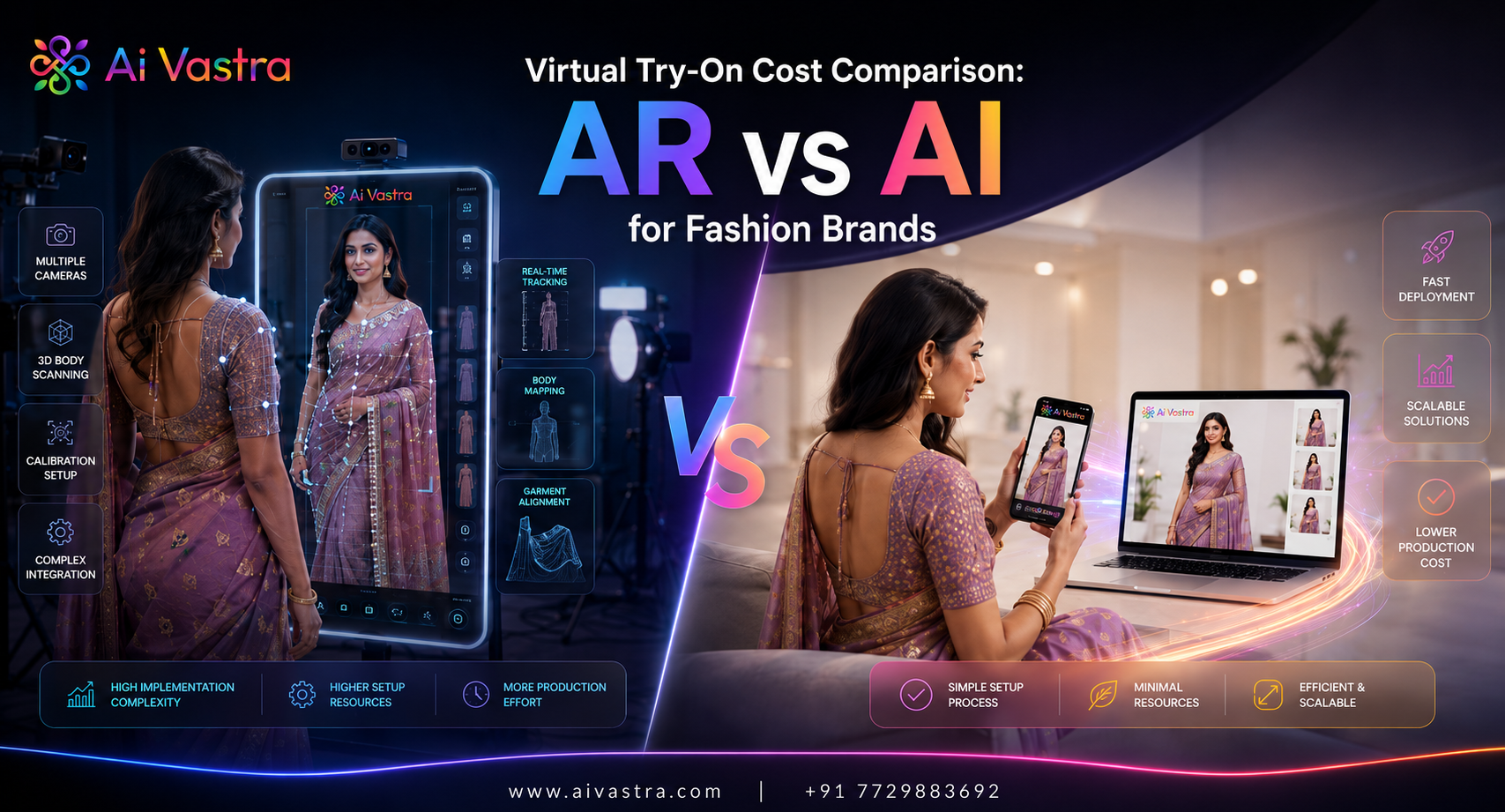
Key Takeaways
- virtual try on cost comparison shows AR integration costs ₹5–50 lakh+ vs AI catalogue photography’s subscription-based model with ₹30–80 per image output costs
- AR virtual try-on delivers strongest ROI for brands with high AOV, high return rates, and technical infrastructure
- AI catalogue photography delivers faster, more measurable ROI for most Indian fashion brands at current scale
- The ar try-on vs ai photoshoot decision isn’t either/or — it’s about sequencing based on your revenue stage
- Virtual fitting room cost includes 3D garment modeling, SDK licensing, and development — all absent from AI catalogue workflows
- Most Indian manufacturers, wholesalers, and growing D2C brands should invest in AI catalogue photography first, and revisit AR try-on as revenue scales
They both aim to solve the same issue, more often than not, helping customers to visualize a garment before purchase. The amount of the investment made and what you get in return are very different things.
If you’re a fashion brand owner or tech decision-maker evaluating where to spend your visual commerce budget in 2026, this virtual try-on cost comparison gives you the honest numbers — what AR integration actually costs, what AI catalogue photography costs, and which delivers better ROI for where your brand is right now.
TL;DR: AR virtual try-on delivers a premium experience but requires ₹5–50 lakh+ in integration and maintenance costs. AI catalogue photography delivers professional on-model images at a fraction of the cost with same-day results — making it the higher-ROI entry point for most Indian fashion brands.
What Does Virtual Try-On Actually Cost to Integrate?
Virtual try-on cost for AR integration ranges from ₹5 lakh to ₹50 lakh or more — depending on SDK licensing, custom development, 3D garment modeling, platform integration, and ongoing maintenance.
Here’s the real virtual try-on cost breakdown:
SDK and Platform Licensing
- Entry-level AR SDKs: Rs 2-8 lakh per annum
- Enterprise AR platforms (Snap, Vertebrae, Zakeke): ₹ 8-25 lakh+ per year
- Custom AR development from scratch: ₹15–50 lakh one-time build cost
3D Garment Modeling
- Each garment needs a 3D digital twin to enable try-on
- Cost per garment model: ₹2,000–₹8,000
- For a catalogue of 300 garments: ₹6–24 lakh in modeling alone
Development and Integration
- Shopify or WooCommerce plugin integration: ₹1–5 lakh
- Custom eCommerce platform integration: ₹5–20 lakh
- Mobile app AR feature build: ₹10–30 lakh
Ongoing Maintenance
- Annual maintenance and updates: ₹2–8 lakh per year
- New garment 3D modeling as catalogue updates: continuous cost
- Platform compatibility updates with new devices and OS versions
Total first-year cost for AR virtual try-on: Conservative estimate: ₹10–20 lakh Mid-tier implementation: ₹25–40 lakh Enterprise full-featured: ₹50 lakh+
This is not a criticism of virtual try-on — it’s a genuinely powerful technology. But the virtual fitting room cost is significant, and for most Indian fashion brands, the question is whether the ROI justifies the entry point.
What Does AI Catalogue Photography Cost in Comparison?
AI catalogue photography costs a fraction of AR virtual try-on — with no 3D modeling requirement, no SDK licensing, and no development overhead — while delivering professional on-model images immediately.
Using AI Vastra:
|
Cost Category |
AR Virtual Try-On |
AI Catalogue Photography |
|
Platform/license |
₹2–25L/year |
Subscription-based |
|
Per-garment setup |
₹2,000–8,000 (3D model) |
Minimal (image upload) |
|
Development cost |
₹1–30L |
₹0 |
|
Maintenance |
₹2–8L/year |
Included |
|
Time to first result |
3–6 months |
Same day |
|
Cost per image output |
Very high initially |
₹30–80 approx |
As we covered in detail in our Fashion Product Photography Cost India guide, AI catalogue photography reduces per-image costs by 60–80% compared to traditional photoshoots — and compared to AR virtual try-on, the entry cost is dramatically lower for the same goal of showing garments on a realistic human figure.
Where Does Each Technology Deliver Better ROI?
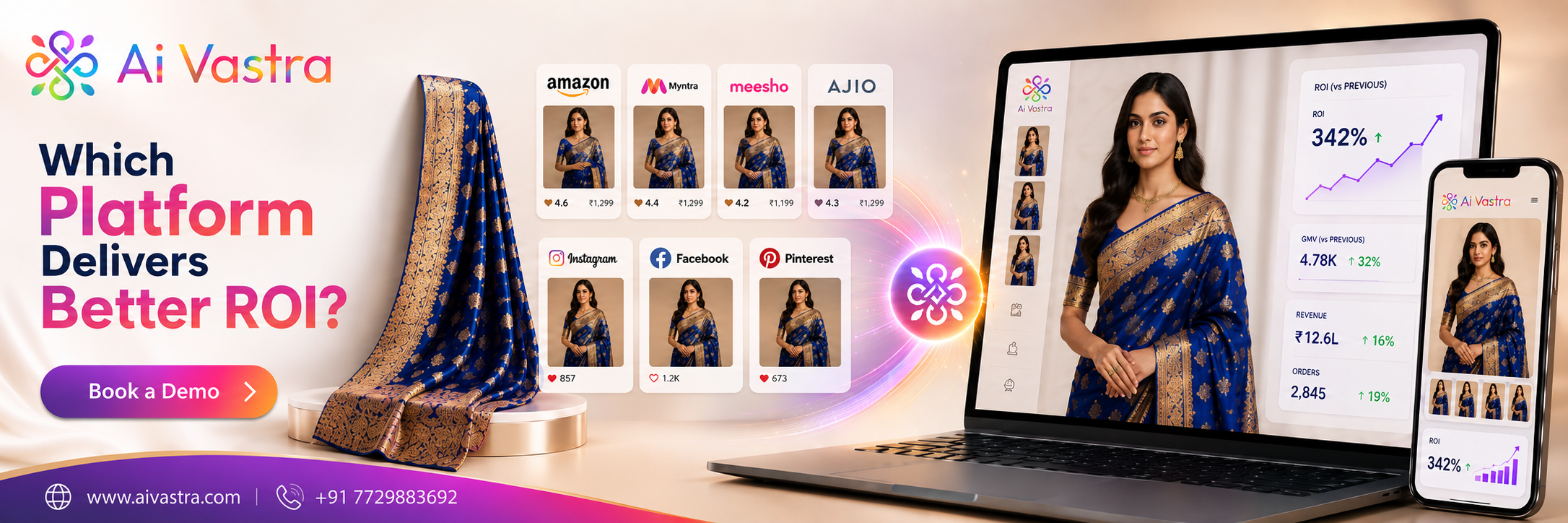
The honest answer on this virtual try-on cost comparison is that each technology has a different ROI profile — and the right choice depends on your brand’s size, catalogue volume, and customer expectations.
Where AR virtual try-on wins:
- High average order value categories where returns are costly (₹5,000+ per order)
- Brands with a loyal customer base willing to engage with new technology
- Large-scale retailers with the development budget and IT team to maintain it
- Markets where customers are already familiar with and expecting AR features
Where AI catalogue photography wins:
- Brands with large catalogues that need professional images quickly
- Manufacturers and wholesalers where per-image cost is a critical metric
- D2C brands on Shopify or Meesho who need listings live fast
- Any brand spending more than ₹50,000 per season on traditional photoshoots
For most Indian fashion brands — saree manufacturers, ethnic wear wholesalers, garment exporters, and growing D2C labels — the ar try-on vs ai photoshoot calculation lands clearly in favour of AI catalogue photography as the primary visual investment, with AR try-on as a potential future addition once revenue and infrastructure support it.
This isn’t about dismissing AR. It’s about sequencing investments correctly. Get your catalogue professional and scalable first. Add AR try-on when your brand volume and customer expectations justify the integration cost.
What Does the Virtual Try-On ROI Actually Look Like?
Virtual try-on ROI is most compelling when it reduces return rates on high-value garments — but the data from Indian fashion markets suggests most brands see stronger ROI from professional catalogue images first.
Published research from western markets shows AR try-on can reduce return rates by 25–40% for high-consideration fashion purchases. That’s meaningful ROI — but only if your current return rate is high enough and your average order value is large enough to justify the integration cost.
For a brand doing ₹30 lakh per month in online sales with a 20% return rate:
- Reducing returns by 30% saves approximately ₹1.8 lakh per month
- That’s ₹21.6 lakh annually — potentially justifying a mid-tier AR investment over 18–24 months
For a brand doing ₹5 lakh per month with a 15% return rate:
- A 30% reduction saves ₹22,500 per month — ₹2.7 lakh annually
- The ROI timeline for a ₹15 lakh AR integration stretches to 5+ years
Compare that to AI catalogue photography virtual try-on roi calculation:
- Saving ₹1 lakh per season on photoshoot costs
- Launching collections 3 weeks earlier (additional revenue opportunity)
- ROI positive from the first season
As we explored in our AI Catalogue vs Traditional Photoshoot comparison, the cost savings alone from AI catalogue photography typically pay for the platform many times over in the first year.
Start with the investment that pays back this season
AI Vastra gives Indian fashion brands professional on-model catalogue images at a fraction of traditional photography costs — with no development overhead, no SDK fees, and same-day delivery.
👉 Book your free demo today and see your ROI from the first batch of images.