 0
0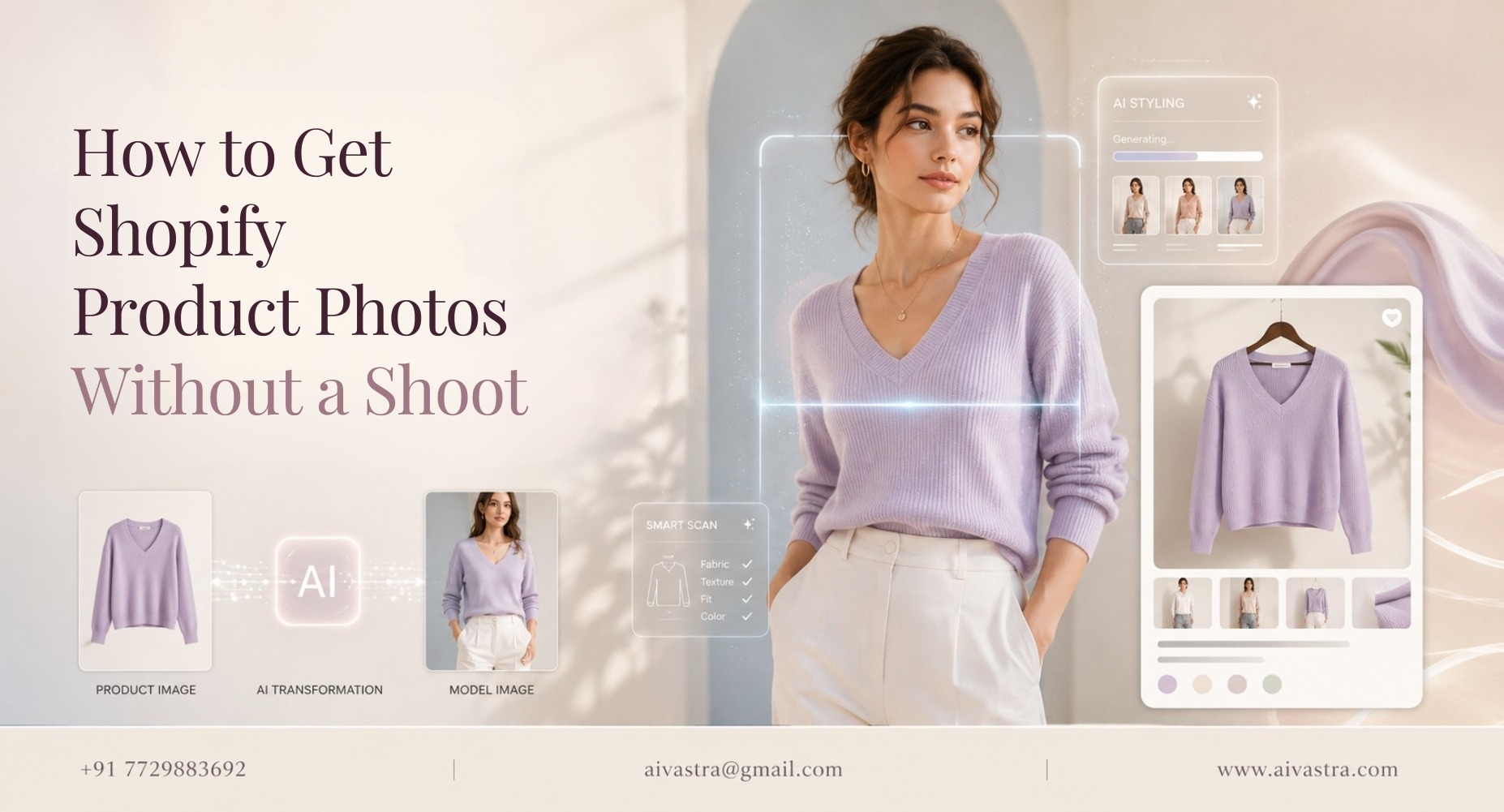
How Shopify Fashion Brands Get Product Photos Without a Photography Budget
You’ve spent months designing your collection. Your Shopify store is ready. And then you realise the product photos are going to cost more than your first month’s inventory.
This is the wall that stops so many indie fashion brands before they even launch. You know bad photos kill conversions. You know flat-lays on your bedroom floor don’t look professional. But a real photographer, a studio, a model — that’s ₹30,000–₹80,000 before you’ve made a single sale.
Here’s the truth: Shopify fashion product photos without photography budget are completely achievable in 2026. Not by compromising on quality — but by using AI catalogue photography that produces professional on-model images from your flat-lay uploads, for a fraction of what any photographer would charge.
TL;DR: Shopify fashion brands can create professional on-model product images using AI Vastra — uploading flat-lay garment photos and receiving finished catalogue images in hours, with consistent quality across their entire store, at a cost that makes sense before revenue starts coming in.
Why Outsourced Photography Creates More Problems Than It Solves for Indie Shopify Brands
The “budget photographer” solution that most indie Shopify fashion brands try first creates a new set of problems: inconsistent lighting, different visual styles across sessions, and a storefront that looks like it was photographed by three different people — because it was.
Here’s what the outsourced photography cycle actually looks like for a small Shopify clothing store:
- Month 1: Find a budget photographer, shoot 15 products, get inconsistent lighting but it’s okay
- Month 2: That photographer isn’t available, hire a different one — different lighting, different editing style
- Month 3: Products have three different visual styles across the store — the storefront looks chaotic
- Month 4: Try to reshoot the Month 1 and 2 products to match Month 3 — more cost, more time
Shopify clothing store product images without photographer involvement avoid this entirely. When every image is generated through the same AI platform with the same model, same background, and same lighting configuration, your store looks like one brand — because visually, it is.
As we covered in our guide on Standardizing Clothing Photos Across Large SKU Catalogues, consistency is the metric that matters most for professional storefront presentation — and it’s the one thing traditional outsourced photography can never guarantee.
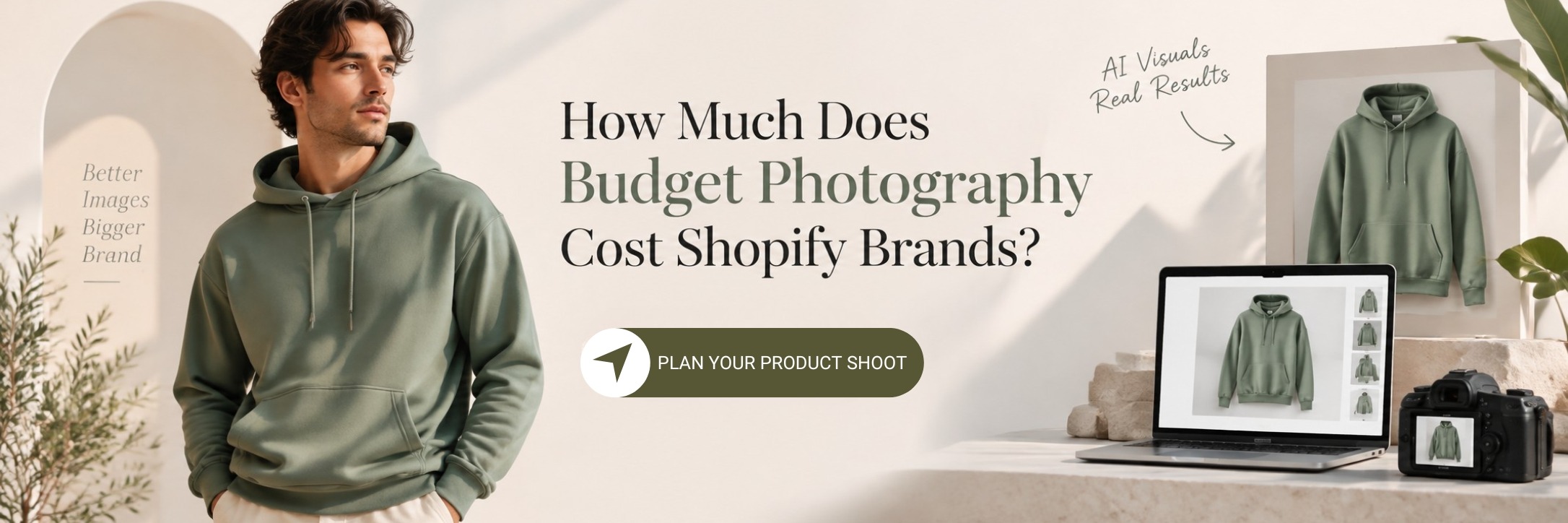
What Does “Budget” Photography Actually Cost an Indie Shopify Brand?
The true cost of affordable product photography for a Shopify India brand adds up faster than most founders expect — making AI product photos for Shopify fashion stores the more economical choice from the very first collection.
Let’s run the real numbers for a 20-product Shopify launch:
“Budget” outsourced photography route:
- Photographer per day budget: ₹6,000–₹12,000
- Studio rental: ₹4,000–₹8,000
- Model (friend or entry-level): ₹2,000–₹5,000
- Editing: ₹50–₹150 per image = ₹1,000–₹3,000 for 20 images
- Total: ₹13,000–₹28,000 for 20 products
- Timeline: 2–3 weeks from booking to final delivery
AI Vastra route:
- Upload 20 flat-lay garment images — phone camera quality is fine
- Select AI model and background preferences
- Receive 20 finished on-model catalogue images within 24 hours
- Cost: fraction of traditional photography, with free trial available
- Timeline: 24–48 hours
For a Shopify brand launching with limited capital, that ₹13,000–₹28,000 difference is meaningful. It’s inventory. It’s Meta ad budget. It’s the difference between launching this month and launching next quarter.
Key Takeaway 1: AI Product Photos for Shopify Cost Less Than One “Budget” Photoshoot
For indie Shopify fashion brands, AI Vastra’s catalogue photography costs significantly less than even a budget photoshoot — and delivers more consistent, professional results across the entire store.
How to Build Your Entire Shopify Product Catalogue Using AI Vastra
Shopify fashion brand catalogue images through AI Vastra are created in a five-step workflow that takes 24–48 hours and requires nothing more than flat-lay photos of your garments.
Here’s the exact process:
Step 1 — Photograph Your Clothes at Home: There’s no need for a studio. Place each piece of clothing on a white or light-colored clean surface. Photograph from directly above with good natural light. A phone camera works fine — you need good light and a clean background, not professional equipment.
Step 2 — Choose Your Brand’s Visual Standard In AI Vastra, select the AI model that represents your target customer — Indian skin tone, appropriate body type, age range. Choose your background (white for clean marketplace look, lifestyle for brand-forward Shopify stores). Set your pose. This becomes your brand standard — every product image will match it.
Step 3 — Upload Your Collection Upload all 20 garment images in a single batch. AI Vastra processes each one with your configured model, background, and pose settings applied consistently across every image.
Step 4 — Export in Shopify-Ready Formats AI Vastra generates images in the dimensions Shopify requires:
- Primary product image: 2048x 2048px (1:1 square) — Shopify’s suggested default size
- 1080 x 1350px (4:5) for Instagram synced listings.
- Minimum recommended: 800 x 800px for positive site load time for mobile pages.
Download all the pictures in the proper format; upload them straight onto your product pages in your Shopify store.
Step 5 — Build a Consistent Storefront Upload each garment’s AI-generated image as the primary product photo. Because every image shares the same model, background, and lighting, your Shopify storefront looks visually unified from the first collection — the professional cohesion that builds customer trust.
Key Takeaway 2: Consistent AI Images Make Your Shopify Store Look Like a Real Brand From Day One
When every product image on your Shopify store uses the same AI model, same background, and same lighting configuration, your storefront communicates brand credibility — the single most important conversion factor for first-time visitors.
Why Consistent Shopify Store Images Convert Better
Indie Shopify fashion product photos without photography budget concerns become a non-issue when AI generates consistent, on-model images — because visual consistency is what drives the purchase confidence that converts browsers into buyers.
Research on eCommerce conversion rates shows consistently that brand visual consistency — not individual image quality — is the primary trust signal for first-time visitors. A Shopify store where product images look like they belong together builds credibility faster than one with technically superior but inconsistent photography.
For a D2C founder building their first Shopify store, this is the practical insight: you don’t need the most expensive photography. You need the most consistent photography. AI delivers that structurally — the same visual parameters applied to every image, automatically.
As we explored in our guide on AI eCommerce Photography and Online Store Conversions, on-model consistent imagery is the highest-impact visual investment an indie Shopify brand can make — and AI makes it accessible at the budget level where indie brands actually operate.
Key Takeaway 3: Fashion brands launching their Shopify stores have been found to do so faster and make faster iterations with the help of AI photography.
AI Product Photographs for Shopify are created in just 24-48 hours, as compared to 2-3 weeks for photography, giving indie fashion brands the ability to launch quickly, test new merchandise more regularly, and refresh their catalogue anytime without photography cancellation.
The accelerated speed builds upon itself. A brand that can add a new product to their Shopify store within 48 hours of finalising the design moves significantly faster than one waiting for photographer availability. In competitive Shopify fashion niches, speed to market is a genuine advantage.