
 0
0
Google Virtual Try-On Is Live in India: What Fashion Sellers Must Do Now
Google’s virtual try-on tool went live in India in December 2025. For Google virtual try-on India fashion sellers, the message is clear; it’s actually a photo-based tool which can enable purchasers to upload a photo of themselves and view which garments featured in the Google shop collection look good on their own physique, directly within their search queries.
Key Takeaways
- The virtual sari, or sharing service, is not supported by Google’s virtual try on yet, but only tops, bottoms, dresses, jackets, and shoes.
- A product data framework and the quality of product images in catalogues now has a direct impact on the visibility as more than 50 billion product listings are linked in Google’s Shopping Graph.
- AI Vastra’s virtual try-on fills the saree and ethnic wear gap Google’s native tool doesn’t yet cover, making the two genuinely complementary rather than competing
What Google’s Virtual Try-On Is and How It Works in India
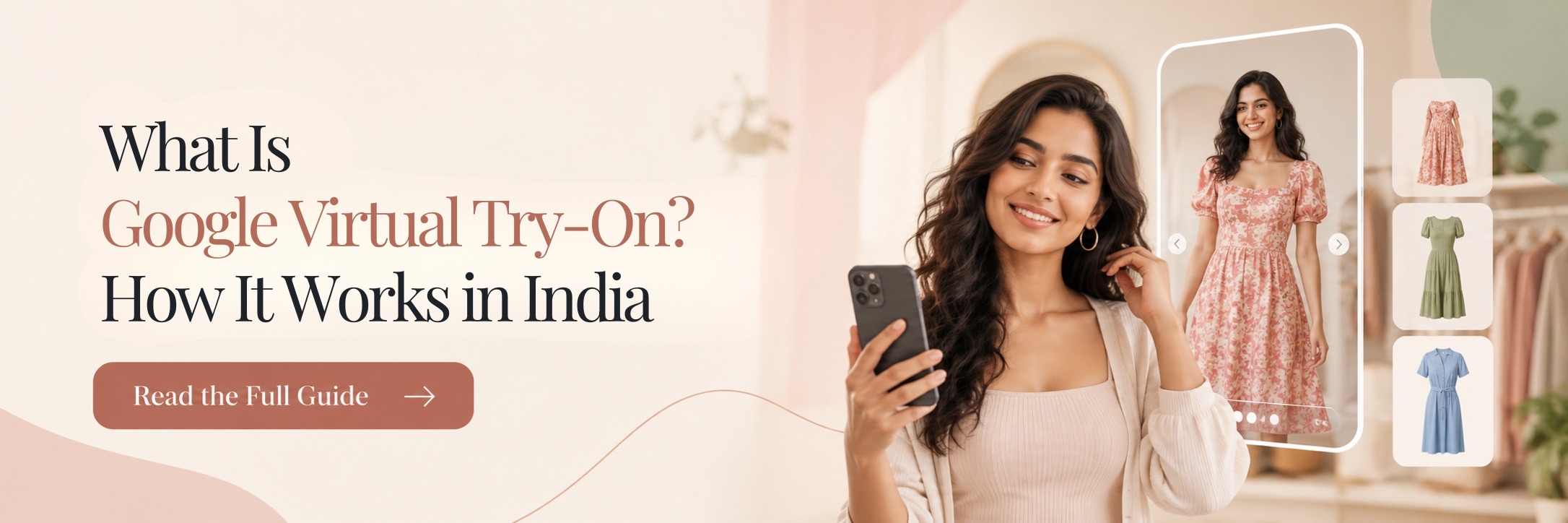
The Virtual Apparel Try-On feature initially debuted in the United States and the UK and was recently introduced to India in December 2025. Shoppers searching Google for apparel items with the ‘Try It On’ icon upload a single, high-quality, full-frontal photo of the desired item. It then uses Google’s own AI fashion model to identify and trace the selected article to the chosen image and take into account the effects of the clothing’s quality (cotton, wool, denim), how it folds, stretches, and drapes against the particular body shape.
Google try it on India leverages the company’s Shopping Graph with over 50 billion product listings, providing the feature’s vast reach as soon as a seller’s listing meets the criteria across categories it supports.
What are the Indian fashion-type categories that are currently supported.
When the Google virtual try-on India fashion sellers brand launches, the product coverage will be tops, bottoms, dresses, jackets, and shoes. This covers a meaningful share of Western-style and casual apparel sold by Indian sellers, but it’s a narrower category set than India’s full fashion market.
Why Saree and Lehenga Sellers Are Not Yet Covered
This is the critical gap for Indian sellers specifically. Google’s currently supported categories don’t include sarees, lehengas, or similarly draped ethnic wear—garments that make up a massive share of India’s fashion e-commerce. The drape, pleating, and pallu structure of a saree is a fundamentally different rendering challenge than a fitted top or dress, and Google’s tool hasn’t extended there yet.
For sellers in this category, Google Virtual Try-On India fashion sellers simply isn’t an available option right now, regardless of how well-prepared their catalogue is.
What This Means for Myntra, Meesho, and Amazon India Sellers
Google Shopping virtual try-on: India sellers on major marketplaces should understand this feature operates through Google’s own shopping surfaces, pulling from listings across the web, not something sellers manually opt into platform by platform. If your listings feed into Google Shopping and fall within a supported category, visibility depends on your existing product data and image quality meeting Google’s standards—not a separate enrollment process.
How AI Vastra’s VTO Differs From and Complements Google’s Tool
This is where the two tools genuinely complement rather than compete. Google’s try-on works from a consumer’s own uploaded photo, within Google’s supported Western-style categories. AI Vastra’s virtual try-on is built specifically for Indian ethnic wear—sarees, lehengas, and draped garments—exactly the category Google doesn’t yet cover.
Our AR Try-On vs. AI Try-On post covers the underlying technical differences between these approaches in more depth, and our AI Virtual Try-On Webcam India post covers how this works for in-store and webcam contexts specifically.
What Sellers Should Do Right Now
How Google virtual try-on works India depends heavily on underlying catalogue quality—this is the real action item for sellers. Three concrete steps:
- Audit catalogue image quality for Google Shopping compliance—ensure listings meet Google’s current image standards, since poor-quality source images limit how well any try-on rendering performs.
- Structure product data for AI discovery—accurate, complete product attributes (category, fabric, fit) help Google’s systems correctly categorize and surface listings.
- For ethnic wear sellers, invest in dedicated AI try-on now—since Google’s native tool doesn’t cover sarees and lehengas, a purpose-built solution like AI Vastra is the practical path to offering this experience to your customers today. See our Best Virtual Try-On Apps India post for a fuller comparison and the Virtual Try-On service page for how to get started.