 0
0
Key Takeaways
Even with a conventional photo shoot to standardize the photos of clothes in a large SKU catalogue, the human variables of the shoot mean that it is hard to ensure that all photos are the same standard.
- Catalogue image consistency directly affects buyer trust, conversion rates, and marketplace algorithm performance
- Core-size automation applies fixed model, background, pose, and lighting parameters to every SKU automatically through AI
- AI Vastra processes 300–500 SKU batches in 24–48 hours with identical visual standards across every image
- Brands see 60–80% cost reduction alongside consistency improvements — making AI the operationally and financially superior choice for large catalogue production
Nothing undermines a professional fashion catalogue faster than inconsistency. Different lighting on page three. A different model on page seven. A different background on page twelve.
Buyers notice. Shoppers notice. And the brand perception damage is real — even when the products themselves are excellent.
For brand managers and catalogue operations teams handling hundreds or thousands of SKUs, Standardizing clothing photos in a large SKU catalogue is one of the hardest operational challenges in fashion. Traditional photoshoots make consistency nearly impossible at scale — every session introduces new variables. AI solves this problem structurally, not just photographically.
TL;DR: To Standardize Clothing Photos for Large SKU Catalogs, you need the same model, same lighting, same background, and same pose applied consistently across every product — something AI catalogue platforms deliver automatically, even for 1,000+ SKU batches.
Why Does Image Inconsistency Hurt Fashion Catalogue Sales?
Inconsistent catalogue images damage buyer trust, reduce conversion rates, and make a brand look operationally unprofessional — even when the individual product images are technically good.
Here’s what inconsistency actually costs fashion brands:
- Wholesale buyers reviewing a 500-piece catalogue expect visual uniformity. When lighting, model, or background changes across the catalogue, it signals disorganized production — and buyers lower their confidence in the brand’s reliability
- eCommerce shoppers scrolling through product listings subconsciously trust brands with consistent imagery more than those with mixed visual styles
- Marketplace algorithms on platforms like Myntra and Meesho factor image quality and consistency into ranking and promotion decisions
- Return rates increase when catalogue images don’t accurately represent how a product looks — inconsistent photography is often the cause
The challenge is that image consistency for catalogues is genuinely hard to maintain across a traditional photoshoot operation. Models change between sessions. Lighting setups vary by studio. Backgrounds get swapped. Over a season with multiple shoot days, inconsistency accumulates.
What Is Core-Size Automation in Fashion Catalogues?
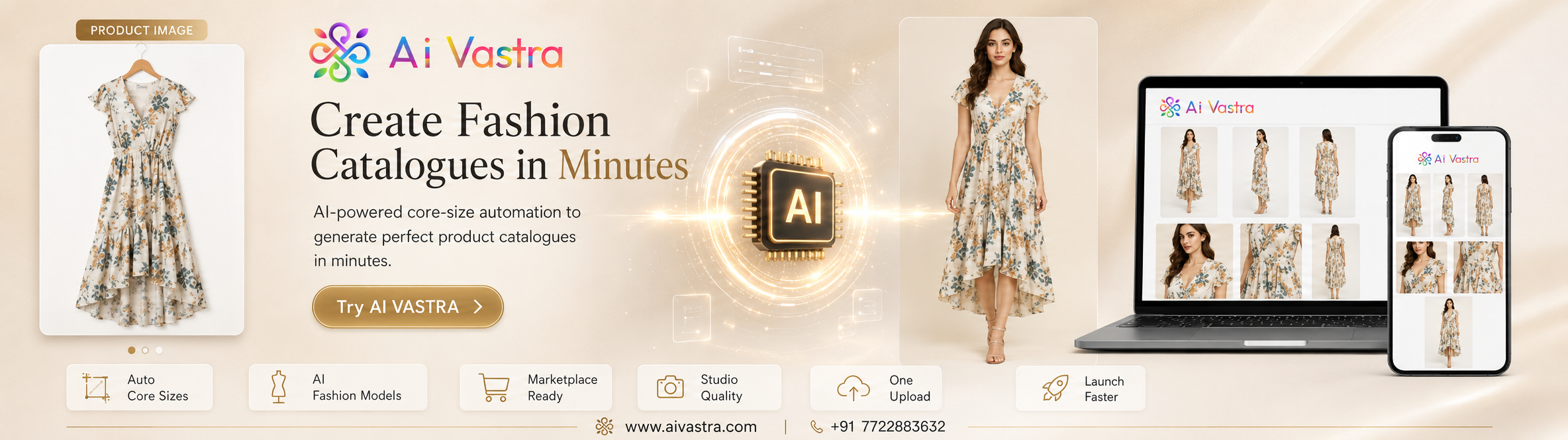
Core-size automation in fashion catalogue photography means using a standardized base model, pose, lighting, and background configuration to generate images for every SKU — ensuring visual uniformity across the entire catalogue regardless of volume.
In traditional photography, “core size” refers to shooting each garment on a single standard model size (typically medium/size M) and using those images as the primary catalogue representation. Core-size automation takes this concept and applies it systematically through AI — so every garment in a 1,000-SKU catalogue is rendered on the same model, in the same pose, with the same lighting, every time.
This is what makes standardized clothing photos large SKU catalogue work at real manufacturer scale. You set your standard once — model, background, pose, lighting style — and the system applies it to every product you upload, automatically.
As we covered in our guide on AI Catalogue Creation for Clothing Manufacturers, this batch consistency is one of the primary reasons large manufacturers are switching to AI catalogue platforms — not just for cost savings, but for the operational reliability that traditional shoots can never guarantee.
How Does AI Vastra Standardize Product Images Across 1,000+ SKUs?
AI Vastra standardizes clothing photos in a large SKU catalogue by applying a fixed visual configuration — model, background, pose, and lighting — to every garment uploaded, processed simultaneously through batch automation.
Here’s the step-by-step process for catalogue teams:
Step 1 — Define Your Visual Standard: Choose your catalogue’s standard AI model (skin tone, body type, height), your background (white, gradient, lifestyle, or brand-specific), your pose configuration, and your image resolution and aspect ratio. This becomes your template.
Step 2 — Upload Your SKU Batch Upload your garment images in bulk — flat-lays, fabric scans, or existing product photos. AI Vastra accepts batch uploads via CSV or direct file upload, handling hundreds of garments in a single session.
Step 3 — Apply Standard Configuration: Your defined visual template is applied to every garment automatically. Same model. Same background. Same lighting simulation. Same pose. Every single SKU.
Step 4 — Quality Review and Download Review the generated images in the platform dashboard. Flag any items for adjustment. Download approved images in your required format and resolution — ready for your catalogue, marketplace listings, or buyer presentations.
Step 5 — Catalogue Integration Images are formatted for direct upload to Shopify, WooCommerce, Meesho, Myntra, or your ERP system — with consistent naming conventions and metadata.
Traditional vs AI: Catalogue Consistency Comparison
The core difference between traditional photoshoots and AI catalogue generation for consistency is that AI applies identical parameters every time — while traditional shoots introduce human variables that accumulate across sessions.
|
Consistency Factor |
Traditional Photoshoot |
AI Vastra |
|
Model consistency |
Changes between sessions |
Identical across all SKUs |
|
Lighting consistency |
Varies by studio and day |
Fixed simulation, always identical |
|
Background consistency |
Can shift between setups |
Defined template, never varies |
|
Pose consistency |
Varies by model and director |
Fixed pose configuration |
|
Consistency at 1,000 SKUs |
Very difficult to maintain |
Automatic |
|
Cost to maintain consistency |
Increases with volume |
Fixed regardless of volume |
|
Time to consistent catalogue |
Weeks across multiple sessions |
Hours in a single batch |
For consistent model photos for clothing brands, this comparison makes the operational case clearly. A brand with 500 seasonal SKUs physically cannot guarantee the same model, studio, and lighting across every shoot day. AI guarantees it structurally.
What Results Do Fashion Brands See After Standardizing Catalogue Images?
Brands that Standardize Clothing Photos for Large SKU Catalogs using AI typically see improved buyer confidence, better marketplace performance, and significant reductions in catalogue production time.
Practical outcomes reported by AI Vastra users:
- Catalogue production time reduced from 4–6 weeks to 24–48 hours for 300–500 SKU batches
- Photography costs are reduced by 60–80% compared to traditional multi-session shoots
- Buyer presentation quality improved — wholesale buyers comment on visual professionalism directly
- Marketplace listing consistency improved, with more products meeting platform image quality standards on first submission
For brands thinking about both consistency and cost together, our article on How AI Reduces Photoshoot Costs for Fashion Brands breaks down where every rupee of savings comes from — complementing the consistency benefits covered here.
AI Vastra helps fashion brands, manufacturers, and catalogue operations teams Standardize Clothing Photos for Large SKU Catalogs — with consistent model, background, pose, and lighting applied automatically to every product you upload.
👉Book your free demo today and see consistent, professional catalogue images across your entire range within 24 hours.