 0
0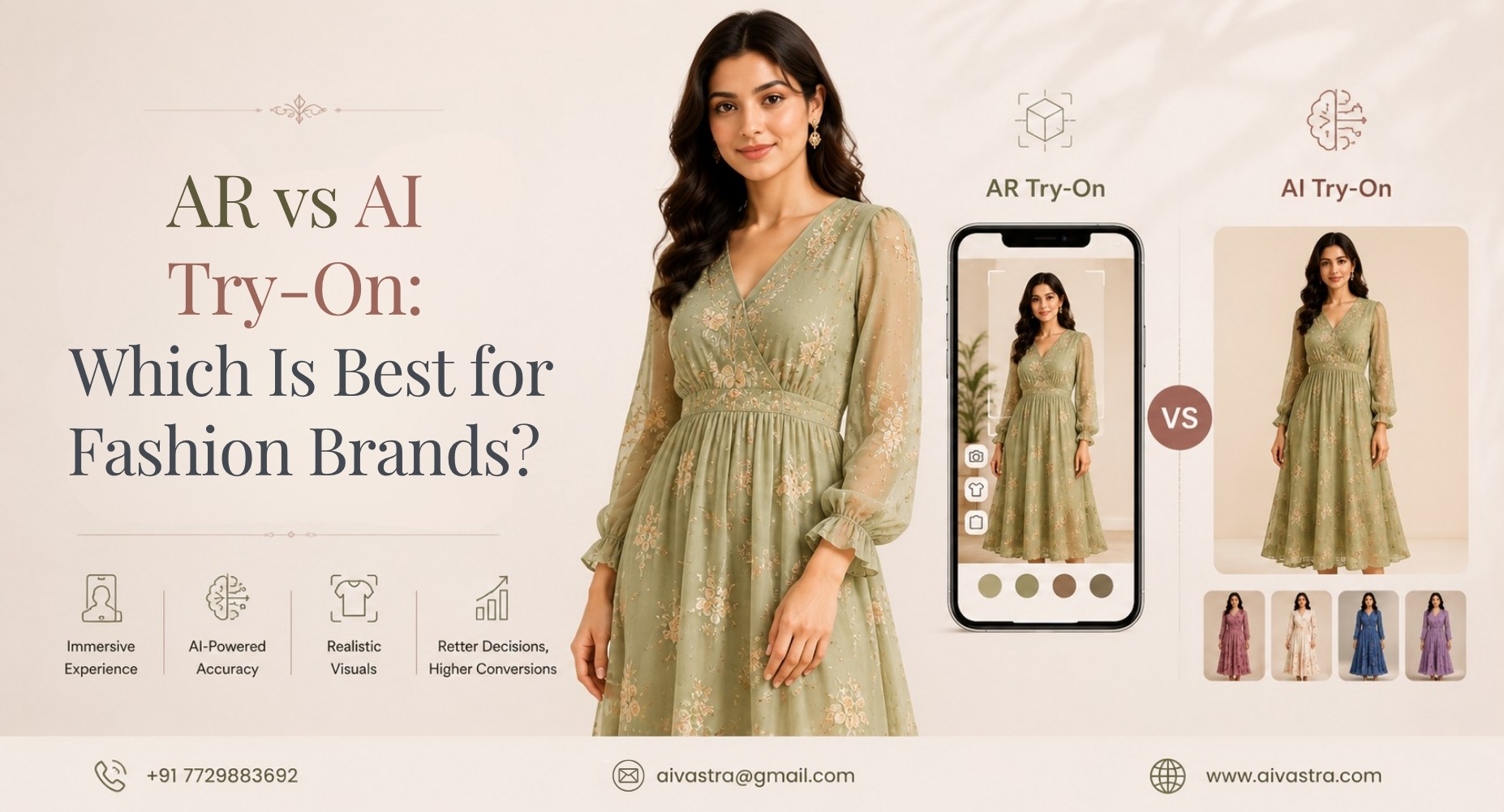
What Is the Difference Between AR Try-On and AI Try-On?
Virtual try-on isn’t one technology – it’s two very different approaches competing for the same goal. Finally, learning the difference between AR try-on vs AI try-on fashion brands is the very first step in making the right selection for your catalogue.
Key Takeaways
- AR try-on uses live camera tracking, similar to a Snapchat filter, while AI try-on uses photo-based garment transfer for a static, realistic image
- AI try-on handles complex draping – sarees, lehengas, dupattas – far more accurately than AR overlay technology
- AI try-on typically costs less to implement and shows stronger conversion impact than AR for most Indian fashion categories
What AR Try-On Actually Is
AR (augmented reality) try-on works through your phone camera in real time. It tracks your body using the camera feed and overlays a digital version of the garment on top of the live video – similar to how Snapchat or Instagram filters work on faces, but applied to clothing.
This creates an interactive, playful experience. Shoppers can move around and see the garment “on them” live. But this real-time tracking has a hard technical limit: it works best on simple, close-fitting garments and struggles significantly with anything structurally complex.
What AI Try-On Actually Is
AI try-on takes a completely different approach. Instead of live camera tracking, it uses a photo – either uploaded by the shopper or a pre-generated model image — and applies garment transfer technology to realistically place the clothing on that photo, accounting for drape, fabric behavior, and fit.
The output is a static, highly realistic image rather than a live camera overlay. This is the same core technology covered in our Virtual Try-On Technology post, which explains how photo-based rendering achieves more accurate results than live tracking.
Why the Two Technologies Serve Different Use Cases
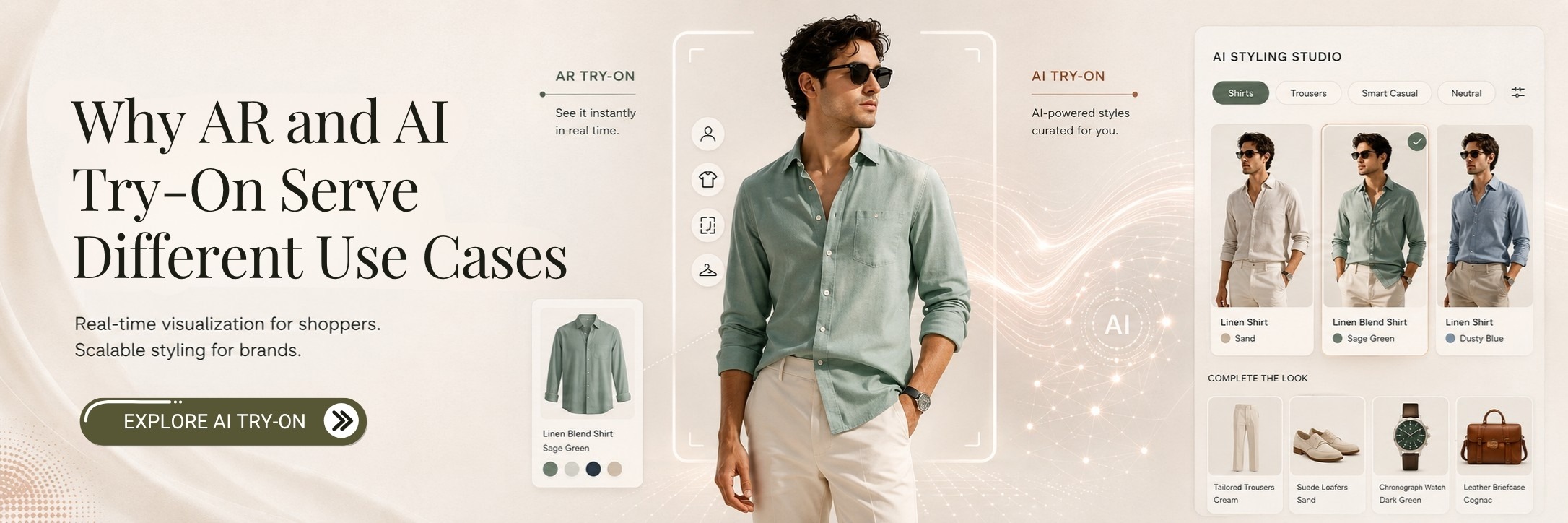
The fundamental difference comes down to what each technology optimizes for. AR optimizes for interactivity and novelty – it’s engaging, especially for simple garments like t-shirts or basic dresses. AI optimizes for accuracy – realistic drape, correct proportions, and true-to-life rendering, especially for complex garments.
When comparing AR try-on vs AI try-on fashion brands, this isn’t really an apples-to-apples comparison of “better” and “worse” – it’s a question of what your catalogue actually needs.
Accuracy Comparison for Indian Ethnic Wear
This is where the gap becomes obvious. Now garments like sarees, lehengas, and dupattas are some of the items that AR try-on fails on, as it’s very difficult to replicate the movement of six yards of fabric on the live camera. The affected outcome is often stiff, skewed or not believable.
AI try-on handles this far better. Since it works from photo-based rendering rather than live tracking, it can accurately simulate how heavy or flowing fabric drapes on a body — a critical requirement for the Indian ethnic wear market, where drape accuracy is often the deciding factor in a purchase.
Cost to Implement Each Technology
AR try-on generally requires SDK integration with specialized camera and body-tracking technology, which tends to be a larger upfront investment and ongoing technical maintenance. AR try on vs ai catalogue cost comparisons consistently show AI as the lower-cost, faster-to-implement option, since it typically works through simpler API-based integration without needing live camera infrastructure.
Our VTO Cost Comparison post breaks this down further with specific cost ranges for both approaches.
ROI: Which Converts Better for Which Category
For AR try-on vs AI try-on fashion brands ROI, the data generally favors AI for most fashion categories, particularly anything involving structured or draped garments. AR performs reasonably well for simple, close-fitting apparel where the novelty factor drives engagement, but it rarely translates that engagement into meaningfully higher conversion for complex garments.
For an AR virtual try on ROI comparison india specifically, the ethnic wear-heavy nature of the Indian market tips the scale further toward AI, since accuracy on complex draping directly impacts buyer confidence and return rates.
Which Indian Brands Use Each Approach
Brands selling primarily simple, Western-style apparel — basic tees, casual dresses — sometimes use AR for its interactive appeal. Brands with ethnic wear-heavy catalogues, or any brand prioritizing conversion and return reduction over novelty, tend to favor AI-based try-on and catalogue generation instead. Our Virtual Try-On vs Catalogue post covers this decision framework in more depth, and the AI Virtual Try-On service page shows how AI Vastra approaches this specifically for Indian garment types.