
 0
0
Key Takeaways
- Virtual try-on for online shopping addresses a real shopper need — purchase confidence — but current AR implementations often fall short of expectations for clothing and ethnic wear
- Indian shoppers want to know how a garment will look on a real person — professional on-model catalogue images answer this question effectively for most purchase decisions
- Image quality drives conversion rates more consistently than AR try-on features for most Indian fashion brands at current scale
- Better catalogue images reduce returns by closing the expectation gap — the same outcome virtual try-on promises
- Virtual try-on clothes online works best as an enhancement on top of strong catalogue image quality — not as a replacement for it
- For most Indian fashion brands, AI catalogue photography delivers higher immediate ROI than AR try-on integration
When asking a consumer about their expectations of the fashion industry online, they commonly reply: “I would simply just like to find out if it will look good on me before buying it.”
That’s the problem virtual try-on for online shopping promises to solve. And it’s a real problem — returns cost Indian fashion eCommerce brands billions annually, and purchase hesitation is the single biggest barrier between a browser and a buyer.
But here’s what most fashion brands get wrong: they assume customers want technology. What customers actually want is confidence. And in 2026, there are two very different ways to give them that.
TL;DR: Shoppers want to feel confident a garment will look good on them before purchasing. Virtual try-on for online shopping can deliver that — but accurate, professional on-model catalogue images solve the same problem for most purchase decisions, without the technology overhead.
What Do Shoppers Actually Want From Virtual Try-On for Online Shopping?
Shoppers using virtual try-on for online shopping aren’t looking for a technical experience — they’re looking for purchase confidence, and they’ll use whatever gives it to them fastest.
Consumer research consistently shows that fashion shoppers have three core questions before buying online:
- Will this fit my body type?
- Will the colour look the way it does on screen?
- Will the fabric move and drape the way I expect?
Virtual try-on for shopping addresses all three — in theory. In practice, the gap between expectation and reality is significant.
What shoppers expect from online shopping virtual try-on features:
- Realistic representation of how the garment fits their specific body
- Accurate colour rendering under different lighting
- Fabric drape simulation that reflects how the garment actually moves
What most AR virtual try-on currently delivers:
- A roughly overlaid garment on a camera image that shifts as you move
- Colour accuracy that varies with phone camera quality and lighting conditions
- Limited fabric physics that often look stiff or artificial on flowing garments
The experience gap is why Online shopping virtual try-on options on Indian platforms see mixed engagement. Shoppers try it once, find the result less realistic than expected, and return to browsing standard product images.
What Is the Current State of Virtual Try-On Indian eCommerce Platforms?
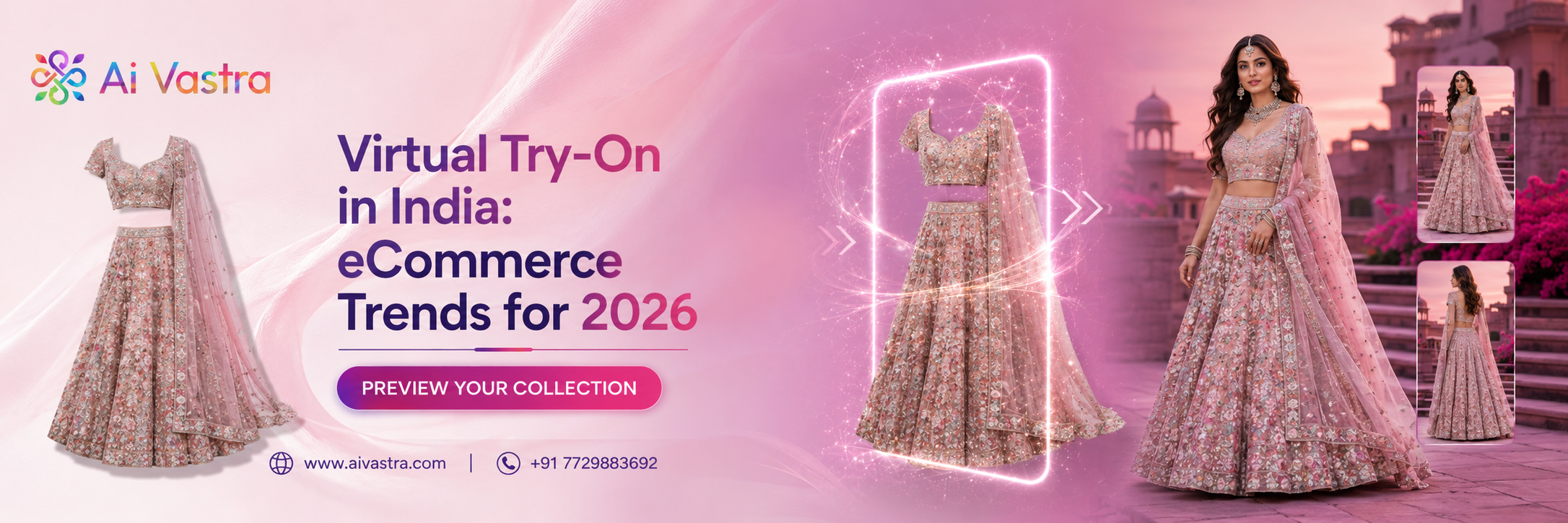
Virtual try-on features on Indian fashion platforms are available but limited — with most implementations offering basic AR overlays that shoppers find useful for accessories and footwear but significantly less convincing for clothing and ethnic wear.
Myntra, Ajio, and a handful of D2C brands have rolled out virtual try-on clothes online features in various forms. Adoption data tells an honest story: the feature is used, but it rarely replaces the need for good product images — it supplements them.
For Indian ethnic wear specifically, the challenge is compounded. A saree with six metres of fabric, regional draping variations, and intricate embroidery is one of the hardest garment types for AR try-on to render convincingly. The physics required to simulate a Banarasi pallu draping correctly over a shoulder — in real time, on a phone camera — are significant.
This is where the conversation gets interesting for fashion brand decision-makers. The technology exists and is improving. But for most purchase decisions on most Indian fashion platforms today, what moves a shopper from hesitation to purchase isn’t a virtual fitting room — it’s a high-quality, on-model catalogue image that shows the garment draped accurately, in context, on a model that resembles the buyer.
Why Do High-Quality Catalogue Images Solve What Virtual Try-On Promises?
Professional on-model catalogue images address the same core shopper anxiety as virtual try-on — “how will this look on a real person?” — without requiring the shopper to engage with any technology.
Consider what a well-produced catalogue image actually communicates:
- Fit and drape — a garment on an AI model with the right body type shows exactly how it falls and sits
- Colour accuracy — professional rendering preserves true colour under consistent lighting
- Fabric behavior — AI draping technology shows how silk, chiffon, georgette, or cotton actually moves
- Styling context — showing the garment worn rather than flat-laid gives the shopper a realistic reference
This is the practical insight that brands spending heavily on AR virtual try-on infrastructure often discover after launch: their conversion rate improvement came less from the VTO feature itself and more from the process of improving their underlying catalogue image quality to enable it.
Better images solve the problem. Virtual try-on enhances it further — but only once the image quality foundation is strong.
AI Vastra’s on-model AI catalogue photography delivers exactly this foundation — realistic garment rendering with accurate draping, correct fabric physics, and Indian model diversity that helps shoppers see themselves in the product. As we covered in our Virtual Try-On vs Catalogue Photography comparison, for most Indian fashion brands at current scale, catalogue image quality has higher immediate ROI than AR try-on integration.
What Does the Data Say About Image Quality and Online Purchase Confidence?
Research consistently shows that image quality is the primary driver of online purchase confidence — with on-model images outperforming flat-lays by significant margins across fashion categories.
Key data points fashion brands should know:
- Products with multiple on-model images see 30–40% higher conversion rates than flat-lay alternatives on comparable listings
- Return rates are measurably lower when catalogue images accurately represent garment drape and colour — reducing the expectation gap that drives most fashion returns
- Mobile shoppers — who represent over 70% of Indian fashion eCommerce traffic — make faster purchase decisions when on-model images load quickly and display clearly
- Wholesale buyers reviewing supplier catalogues consistently cite image consistency and model presentation as key factors in shortlisting decisions
For ethnic wear brands specifically, accurate draping images reduce the single biggest purchase hesitation: “I don’t know how this saree will drape on me.” A realistic on-model image with correct pallu and pleat presentation answers that question more convincingly than most current AR implementations.
Give your shoppers the confidence to buy — starting with images that show your products accurately.
AI Vastra helps Indian fashion brands create professional on-model catalogue images that answer shoppers’ real questions — how does this look on a real person, in the right drape, with accurate colour and fabric detail.
👉 Book your free demo today and start reducing purchase hesitation with better catalogue images from day one.